Specimen 17042026 · H&E · 40×
Grade group 3 → 4 disagreement zone
Seed A — open Indication 01 · Prostate FDA pre-submission

A second layer of intelligence for pathology.

PathMDAi is a clinical intelligence layer for prostate cancer diagnosis — built for the disagreement zones where the field already disagrees with itself. Not a model. Not a dashboard. A second layer.

We don’t replace the pathologist’s eye. We hand them a second one, trained on the molecular layer they can’t see.
— Founding thesis · 2024
The wedge

Built for the ambiguity zones of cancer diagnosis.

Inter-pathologist disagreement on prostate Gleason 3 versus 4 routinely runs above thirty percent. That single gap drives over- and under-treatment, biopsy re-reads, and the slow, costly tail of clinical uncertainty.

PathMDAi does not compete with the pathologist’s sign-out. It illuminates the regions where the field already disagrees with itself, and gives the reviewer a structured second opinion — with confidence, evidence, and the tiles that produced each call.

// Plate · Gleason classification (1966) schematic — H&E architecture
Where the field splits: pattern 3 versus pattern 4.
03 · A Discrete, well-formed glands. Each unit individually identifiable.
03 · B Mild size variability. Glands still clearly separated.
04 · A Fused glands. Individual borders lost. Adjacent units share walls.
04 · B Cribriform: one mass perforated by lumina. No discrete glands.
↑   the diagnostic boundary   ↓

The visual difference between pattern 3 and 4 is the presence of glandular boundaries. The transition is the single most consequential — and most disputed — call in prostate pathology.

~30%inter-rater disagreement · 3 ↔ 4
Same slide. Ten readers. // illustrative · n=10
disagreement zone
GS 3+3 GS 3+4 GS 4+3 GS 4+4
A single borderline case, scored by ten genitourinary pathologists. Treatment implication: active surveillancedefinitive therapy
Discipline

What we are not.

Computational pathology has a credibility problem because the category over-promised. Our position is defined as much by what we refuse to be as by what we build.

// Not this
  • Autonomous diagnosis
  • Replacement pathology
  • Black-box grading
  • Autopilot sign-out
  • "AI that disrupts the pathologist"
// Instead
  • Ambiguity-aware review
  • Structured evidence
  • Pathologist-controlled co-pilot
  • Auditable disagreement
  • A second layer the reviewer decides whether to use
Report fragment
A cropped excerpt — the structured evidence layer that accompanies every reviewed case.
// crop · 1 of 6
Case · PID-38 · Slide 3+3 NB 2026-04-17 · 10:22
Ambiguity flag
Borderline 3+3 / 3+4 — focal cribriform pattern, mean ambiguity 0.63
Confidence distribution
GS3 · 27.3% Evidence strength: MEDIUM GS4 · 72.7%
Provenance
model · pmd-gu-grade-v0.4.2 (frozen 2026-03-09)
tiles · 1,284 evaluated · 412 cancer-dominant · 11.2% ambiguous (<60% confidence)
stains · H&E baseline · IHC overlay deferred
Reviewer override · audit trail
Dr. M. Doe · accepted 3+4 (GG2) · noted focal pattern 4 in apical cores · 2026-04-17 07:31
→ disagreement with model: NONE · evidence reviewed: 6 / 6 tiles
The layer

One cinematic path. Slide to sign-out.

No feature grid. No dashboard tour. The intelligence layer is a single workflow — five steps, every one auditable, every one keeping the pathologist in command.

01 · Tissue

Whole-slide ingest

H&E whole-slide images are normalized for stain, scanner, and institution drift before any inference runs. Architected for future LIS interoperability — not yet integrated.

02 · Ambiguity

Disagreement detection

The model surfaces the regions where field consensus historically breaks down — not where it is most confident, but where pathologists most need a second look.

03 · Review

Pathologist in command

Every flag is reviewable, overridable, and traceable. The co-pilot defers to the sign-out. Modifications are first-class objects in the report — not asterisks.

04 · Evidence

Structured provenance

Confidence, evidence strength, and the tiles used to derive each call are recorded as structured metadata — readable by a reviewer, an auditor, and a regulator.

05 · Diagnosis

Final sign-out

The pathologist retains final authority. The layer supports — never supplants — the review. What remains is a more confident report and an audit trail a regulator can read.

The viewer

Where the reviewer actually sits.

The five-step pipeline lives inside a single surface. Whole-slide field on the left, multi-block carousel and structured annotations on the right, AI Assistant a tab away. The pathologist controls every call.
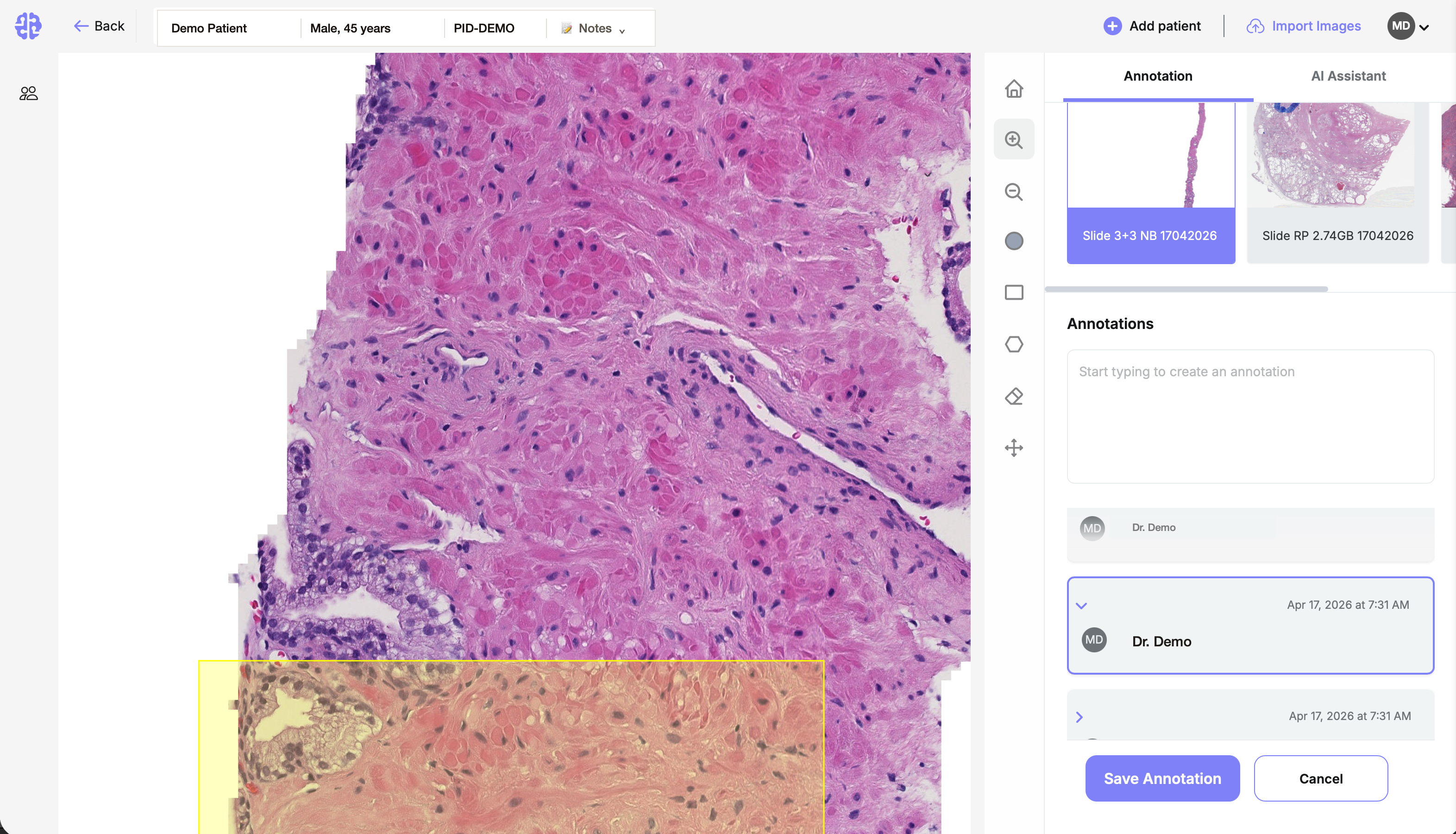
// PathMDAi   reviewer surface · validation build Specimen · NB 17042026 Stain · H&E Indication · Prostate
PathMDAi reviewer surface — whole-slide pathology viewer with annotation panel and AI Assistant
A · Whole-slide field Pan, zoom, and traverse at native resolution. Stain-normalized H&E tiles rendered at scanner resolution. The reviewer’s working surface — same one they trained on.
B · Annotation Every mark is auditable, every override logged. Free-text, region, and polygon annotations are first-class objects. Reviewer identity, timestamp, and provenance attach to each.
C · AI Assistant A second opinion, one tab away. Disagreement zones, confidence distribution, and tile-level evidence — surfaced when the reviewer asks, deferred to when they don’t.
// Build · 2026.04 · pathologist-in-the-loop Demo patient · all PHI redacted. The reviewer’s authority is not. // Co-pilot, not autopilot
Why now

Every prostate biopsy is becoming computational.

Five forces are converging in the same window. Pathology AI is no longer a research curiosity — it is the operating layer the next decade of oncology will be built on.

01 Digital pathology has crossed the line Whole-slide scanners are now standard equipment in academic and reference labs; the slide is finally a digital object the rest of the stack can touch.
02 Pathologist shortage is structural Caseload per pathologist is rising globally while training pipelines flatten. The economic case for a co-pilot has stopped being aspirational.
03 FDA has a pathway SaMD guidance on AI co-pilots, predetermined change control, and good machine-learning practice now define a real submission lane.
04 Reimbursement is moving Digital pathology and AI-assist CPT pathways are progressing. Procurement can budget against codes for the first time, not pilots.
05 Oncology has gone molecular Treatment is increasingly molecularly contextual. The diagnosis layer must speak that language or be cut out of the loop.
The science

Peer-reviewed before productized.

Our grading model was characterized for bias and generalizability in npj Precision Oncology before a single hospital deployed it. Read the work, then read the pitch.

2025 npj Precision Oncology Bias and generalizability in AI-driven Gleason grading Read · Nature →
2024 J. Personalized Medicine Synthetic genitourinary pathology images via generative models Read · MDPI →
2026 In review Generative prostate MRI for equity-aware model training Pre-print pending
2026 Position paper Multi-modal AI for precision cancer diagnostics On request
Institutional capability

The people behind the layer.

A research-led group of computational pathology operators, clinical leadership, and translational collaborators. Treated as a masthead, not a culture page.

01 Leadership & Operations

Himanshu Arora, PhD

Founder & Chief Executive Officer

Computational pathology and translational AI researcher focused on uncertainty-aware diagnostic systems and multi-modal oncology infrastructure.

Erik Stettler

Chief Financial Officer

Health-tech operator focused on capital strategy, regulatory finance, and institutional partnerships.

Derek Van Booven, MS

Director of Data Science

Computational biologist and bioinformatics researcher leading data strategy, validation, and model development.

Deep A.

Chief Technology Officer

Leads platform engineering, infrastructure architecture, and deployment systems for PathMDAi.

02 Clinical & Scientific Leadership

Sheetal Malpani, MD

Clinical Lead, Pathology Integration
Assistant Professor of Pathology, LECOM

Leads pathology workflow integration, clinical evaluation, and pathologist-facing AI review strategy.

Aijan Tolenovna Ukudeeva, MD

Associate Clinical Lead, Pathology Integration
Pathologist, Vandalia Health

Supports pathology evaluation workflows and clinical review integration for validation-stage deployments.

Rehana Qureshi, PhD

Academic Lead

Principal investigator focused on methodological rigor, translational research, and publication strategy.

03 Research & Clinical Collaborators

Cheng-Bang Chen, PhD

Biomedical engineer & Assistant Professor
University of Miami

Research collaborator focused on translational imaging systems and computational medicine.

Murugesan Manoharan, MD

Professor & Chair of Urologic Oncology
Baptist Health Miami Cancer Institute

Clinical collaborator supporting translational evaluation and future validation discussions in genitourinary oncology.

Institutional readiness

Built to be deployed, not piloted forever.

An intelligence layer is judged by what it does the day after the demo ends. Six commitments make PathMDAi a system a hospital’s legal, IT, and clinical leadership can sign for.

01 · Interoperability

Architected for future LIS

Designed with institutional deployment in mind. The data model and review surface are shaped to drop into existing pathology workflows when integration work begins. Not yet integrated.

02 · Deployment

Federated by design

The architecture trains where the data lives. PHI is not designed to leave the institution’s perimeter. HIPAA-aligned by construction.

03 · Auditability

Every call is reviewable

Confidence, evidence strength, and the regions used to derive every output are stored as structured records — readable by a regulator, a reviewer, and a malpractice attorney.

04 · Override

The pathologist wins

Every flag is overridable. Every override is logged. The sign-out belongs to the human, full stop.

05 · Provenance

Confidence is traceable

Each output is tied to the cohorts, model versions, and tile-level evidence that produced it. Versioning is a first-class concern, not a release note.

06 · Workflow

The reviewer still decides

Every output is provisional until a pathologist signs. Modifications, overrides, and second-reads are first-class objects in the report — not asterisks.

Current status

Validation-stage. Honestly labeled.

We do not pretend to be further along than we are. The candor is the moat.

Regulatory
FDA pre-submission underway
Product
Validation-stage co-pilot · MVP complete
Deployment
Research-use · pathologist-in-the-loop
Cohorts
Multi-institutional evaluation
EHR / LIS
Not yet integrated · architected for it
Authority
The pathologist signs. Always.
We publish what we get wrong.

Most AI vendors ship accuracy claims and a license agreement. We characterize our failure modes in peer review before we ask a hospital to deploy. That is the credibility bar regulators, payers, and senior pathologists actually use.

— Identity · operating principle 01
For investors

Back the operating layer, not another model.

Seed A is open. Use of proceeds: take the prostate co-pilot through FDA submission, add a third validating institution, and harden the federated deployment surface. Memo, cohort, and product walkthrough are shared with qualified investors after a fifteen-minute call.

RoundSeed A · open
StageMVP complete
RegulatoryFDA pre-sub
IndicationProstate · 01
Cohorts3 institutions
Slides12k+ validated